




 Translate
-
* News
- - Agira 2018, 75 years later
- - Agira 2013, 70 years later
- - Gallery of ceremony 2013
- - Operation Husky 2013
- - Documentary Series 2023
- * Historical Info
- * Historical Movies
- * Remembrance Trail
- * Canadian Battles
- * Italian Defensive Positions
- * Students' Contribute
- * About Us
- * Visitor's Book
- * Collaborators
- * Bibliography
- * Testimonials
- Biographies
- * Catania War Cemetery
- * Moro River War Cemetery
- * Syracuse War Cemetery







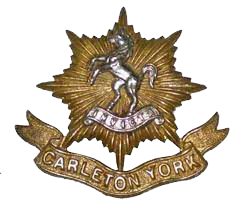
Carleton and York Regiment, R.C.I.C.
On september 1943 near Messina, Sicily, the Battle of Sicily is over and the Carleton & York Regiment awaits it's turn to cross the Strait of Messina and take the fight to the Italian mainland.
The Battle of Sicily was the opening move in the Italian Campaign of the Second World War. The battle would also mark the first protracted combat deployment of a Canadian formation during the war.
The Allied invasion of Sicily began with parachute assaults on the night of 9-10 Jul 1943, followed by amphibious landings in several locations on the south coast the next morning. Operation HUSKY was the largest amphibious operation of the Second World War up to that point in time, in terms of troops involved.
The battle served as an effective indoctrination for the Canadians involved; Major General Guy Simonds and subordinate commanders received battle experience and by all accounts handled the division well. Canadian soldiers also received accolades from both higher command and their German enemies for their conduct of the battle.
Allied grand strategists had long discussed the options available to them for re-entering the continent of Europe and liberating it from The Axis. The entry of the United States into the war in Dec 1941 gave great impetus to the planning for such a venture. At the time of the Dieppe Raid in Aug 1942, many in the Allied camp were still calling for a direct invasion of France. With considerable forces already engaged in North Africa, Britain and the US expanded their efforts there. Canadian participation had been limited to the attachment of individuals to British units in order to gain battle experience. With the defeat of Axis troops in Tunisia in May 1943, the next phase of Allied strategy had already been determined: an invasion of Sicily.
 A map of Sicily showing the Canadian and Allied advance across the island.
The decision to attack Italy rather than France has continued to be debated by historians. Equally controversial, then and in ongoing debates since the war, has been the decision to split the forces making up First Canadian Army in the UK. The 1st Canadian Infantry Division and the 1st Canadian Army Tank Brigade were both selected for employment in Operation HUSKY.
US forces landed in the Gulf of Gela with British forces landing on the south-eastern portion of the island. The initial landings of US forces were met with heavy resistance, including a counter-attack by armour of the Hermann Goering division. Strong winds hampered the airborne assault, and when airborne reserves were called in on the second day of the invasion, a costly friendly fire incident saw several transport planes shot down by the Allied fleet in the belief they were German bombers.
The Canadian landings near Pachino were done on a two-brigade front, with spirited resistance offered against only one of the brigades. Many transport vehicles and items of equipment had been lost by the 1st Division when a ship was torpedoed and sunk on the way to Sicily.
Once ashore, there was no master plan to co-ordinate the activities of the US 7th Army and the British 8th Army, and the two formations operated independently during the campaign.
After initial heavy counter-attacks against the Americans, which were repulsed by the use of naval gunfire, resistance stiffened on the British front while US forces broke away from the beachhead. Faced with the formidable obstacle of Mount Etna, the 8th Army commander, General Montgomery, persuaded the 15th Army Group commander, General Alexander, to shift the inter-army boundary and allow room to maneuver to the west. During this operation, the US 45th Infantry Division was forced to break contact with the XIV Panzer Corps, which escaped a likely encirclement.
The 1st Canadian Division - described by Montgomery as "fat" - were given time to rest and acclimate (while most of the 8th Army formations were veterans of the desert, the Canadians had moved to the Mediterranean from Scotland where they underwent amphibious and mountain operations training). Once they were moving, they first saw action at Grammichele and Piazza Armerina.
 Soldiers of the Carleton & York Regiment move inland near Pachino, Sicily, 10 July 1943.
Other actions to the north included Valguarnera on 17-18 Jul, the first true divisional operation of the war for Canadian soldiers. The Canadians traded 140 casualties for 500 Germans killed, wounded and captured. The battle saw the first combat use of the Projector, Infantry, Anti-Tank, the first combat shoot of the entire divisional artillery, and the first true combat actions for several battalions such as the Carleton & York Regiment.
The US 7th Army, relieved of the burden of fighting up the centre of the island where the Canadians and British were now employed, pressed to the northwest in an impressive but tactically irrelevant sweep to capture the city of Palermo. Strategically, the capture of Palermo led to a coup that deposed Mussolini, Italy's dictator and war leader.
Both the 7th and 8th Armies now turned to the task of capturing Messina, and heavy resistance was offered both armies. Canadian successes described as "brilliant" took place in the hilly terrain southwest of Mt. Etna from 20-22 Jul, including a surprise night attack by the 1st Brigade at Assoro which was followed by successful defence against persistent counter-attacks, and the capture of Leonforte by the 2nd Brigade.
As the Allies raced to Messina, substantial numbers of German troops with their equipment managed to withdraw to the Italian mainland. Some 100,000 men and 10,000 vehicles were so evacuated during the course of the battle.
The battle officially ended on 17 Aug 1943 after Allied troops entered Messina and the last Axis forces on the island surrendered. In all the Allied campaign had lasted 38 days, in wich the Axis suffered 29,000 killed and wounded and 140,000 (mostly Italians) taken prisoner.
 LGen McNaughton speaking with officers of the CYR, Sicily, 20 August 1943. L to R: LCol JEC Pangman, LGen McNaughton, Lt Harry Stark, Lt Gray Maxwell, Lt Pete Mackenzie, Maj Bud Steen, unidentified, unidentified.
Photo Credit: WOODSTOCK, NB Memories of the past and present FB page.
Canadian troops remained in Sicily in anticipation of the next phase of the Italian Campaign which began with the Landings at Reggio in September 1943.
During the Battle of Sicily the Carleton & York Regiment spent 29 days in active operations during the course os which they advanced about 140 miles, nearly all of it on their feet, in very trying conditions of heat and dust, often in rugged terrain impassable to mechanized transport, and for most of the time in contact with the enemy.
In Sicily the Carleton & Yorks suffered 6 officers wounded, 1 died of wounds, and 2 killed in action. For the other ranks the totals were 70 wounded, 11 died of wounds, and 22 killed in action.
For their service and sacrifice during the Battle of Sicily the Carleton & York Regiment was awarded he Battle Honour, SICILY, 1943.
Information from: www.canadiansoldiers.com , and the book “INVICTA, The Carleton and York Regiment in the Second World War”, by Robert Tooley.
INVICTA
SPEM REDUXIT